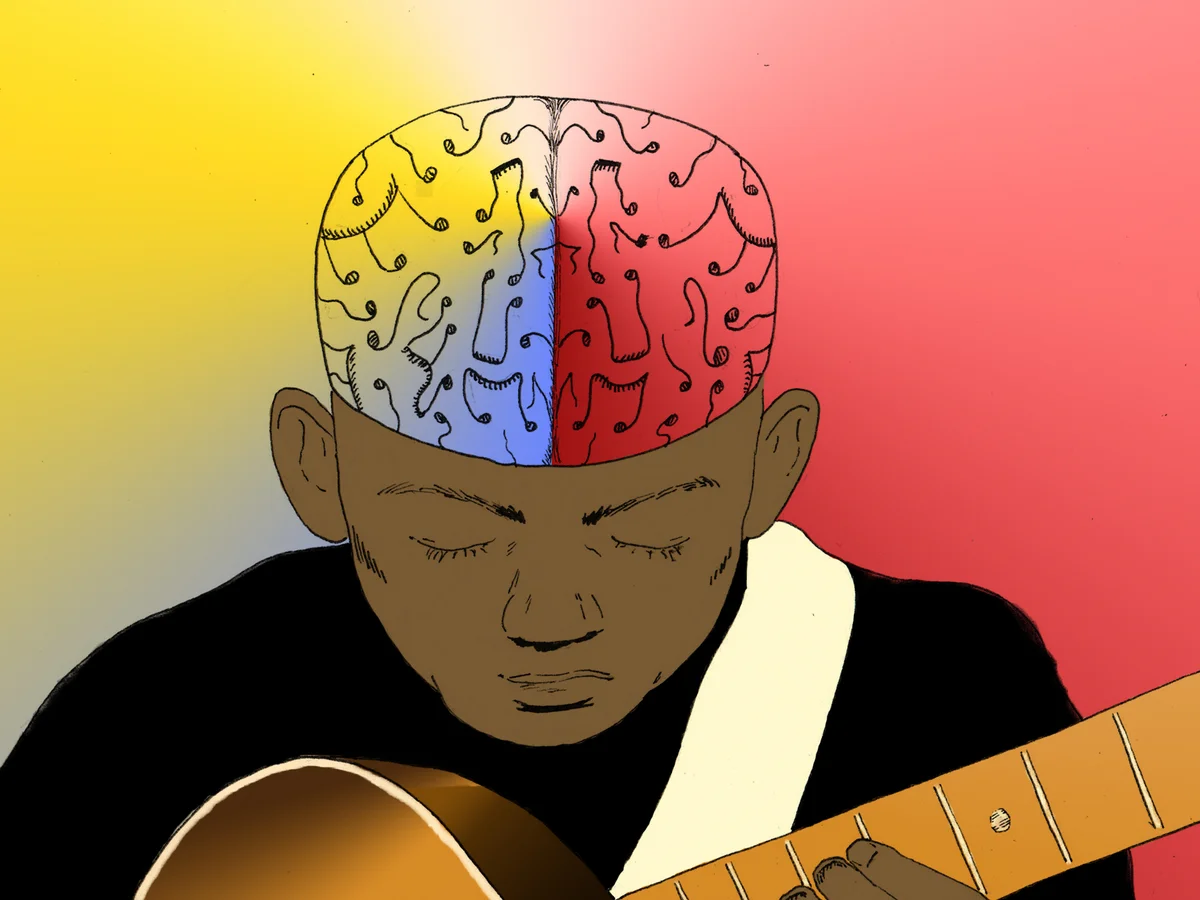
When you practice guitar, you're not just training your fingers — you're literally rewiring your brain. Understanding the neuroscience of guitar learning can transform how you approach practice and help you optimize your improvement.
The brain structures involved: Learning guitar engages multiple brain regions simultaneously. The motor cortex controls your hand and finger movements. The cerebellum coordinates timing and fine motor control. The auditory cortex processes the sounds you produce. The prefrontal cortex handles conscious decision-making and focus. The hippocampus stores new memories. The basal ganglia helps automate learned movements.
What happens when you learn something new: Initially, novel movements require massive brain effort. Neural signals travel slow, inefficient pathways. Your prefrontal cortex (conscious thought) must micromanage every action. This is why beginners need to look at their fingers and can't hold conversations while playing — their working memory is maxed out.
With repetition, something remarkable occurs: myelination. Myelin is a fatty substance that wraps around frequently-used neural pathways, dramatically increasing signal speed. The more you repeat an action, the more myelin builds up. What once required conscious effort becomes automatic.
Sleep consolidates learning: During sleep, your brain replays the day's practice sessions, strengthening the neural pathways involved. Studies show that motor skill performance improves after sleep, even without additional practice. This is why consistent daily practice (followed by good sleep) outperforms marathon sessions followed by exhaustion.
The spacing effect: Your brain learns better when practice is distributed over time rather than massed into single sessions. Practicing 15 minutes daily creates stronger neural pathways than practicing 2 hours once a week. Each session activates pathways; the gaps between sessions allow consolidation; the next session builds on a stronger foundation.
Neuroplasticity doesn't end with childhood: While children's brains are more plastic, adult brains retain significant neuroplasticity throughout life. Brain imaging studies of adult musicians show continued structural changes — thicker gray matter in motor and auditory regions, stronger connections between hemispheres — regardless of the age they started learning.
What this means for your practice:
Consistency beats intensity. Daily short sessions leverage the spacing effect and provide regular sleep-consolidation opportunities. Your brain needs time to process each session before the next one.
Sleep is not negotiable. Skimping on sleep undermines practice by preventing consolidation. Prioritize good sleep hygiene, especially during periods of intensive learning.
Challenge is necessary. Easy practice doesn't drive neuroplasticity; challenge does. If something feels effortless, it's not growing your brain much. Push into slightly uncomfortable territory.
Focus matters. Distracted practice creates weak neural pathways. Deep, concentrated practice creates strong ones. Put away your phone, minimize interruptions, and fully engage.
Real-time feedback accelerates rewiring. The faster you correct errors, the faster you build correct pathways. This is why Chordie AI's instant feedback is neurologically superior to practicing without feedback and only getting correction at weekly lessons.
Visualization works. Mental rehearsal activates many of the same brain regions as physical practice. When you can't have your guitar, visualizing yourself playing still strengthens neural pathways.
Variation enhances learning. Practicing the same thing the exact same way creates narrow neural pathways. Introducing variation (different tempos, different songs with similar techniques) creates flexible, resilient skill.
The implications are empowering: Your brain is designed to learn guitar. The neural machinery is there — it just needs proper stimulation through consistent, focused, feedback-rich practice. Understanding the neuroscience helps you stop fighting your biology and start leveraging it.
Every practice session is sculpting your brain. The guitarist you become is being physically constructed in your neural tissue. With the right approach, there's no ceiling on what you can achieve.
Chordie Team
VerifiedMusic Education Experts
The Chordie Team consists of professional guitarists, music educators, and AI engineers passionate about making guitar learning accessible to everyone. With decades of combined teaching experience, we create content backed by proven pedagogical methods.
Learn more about usShare this article