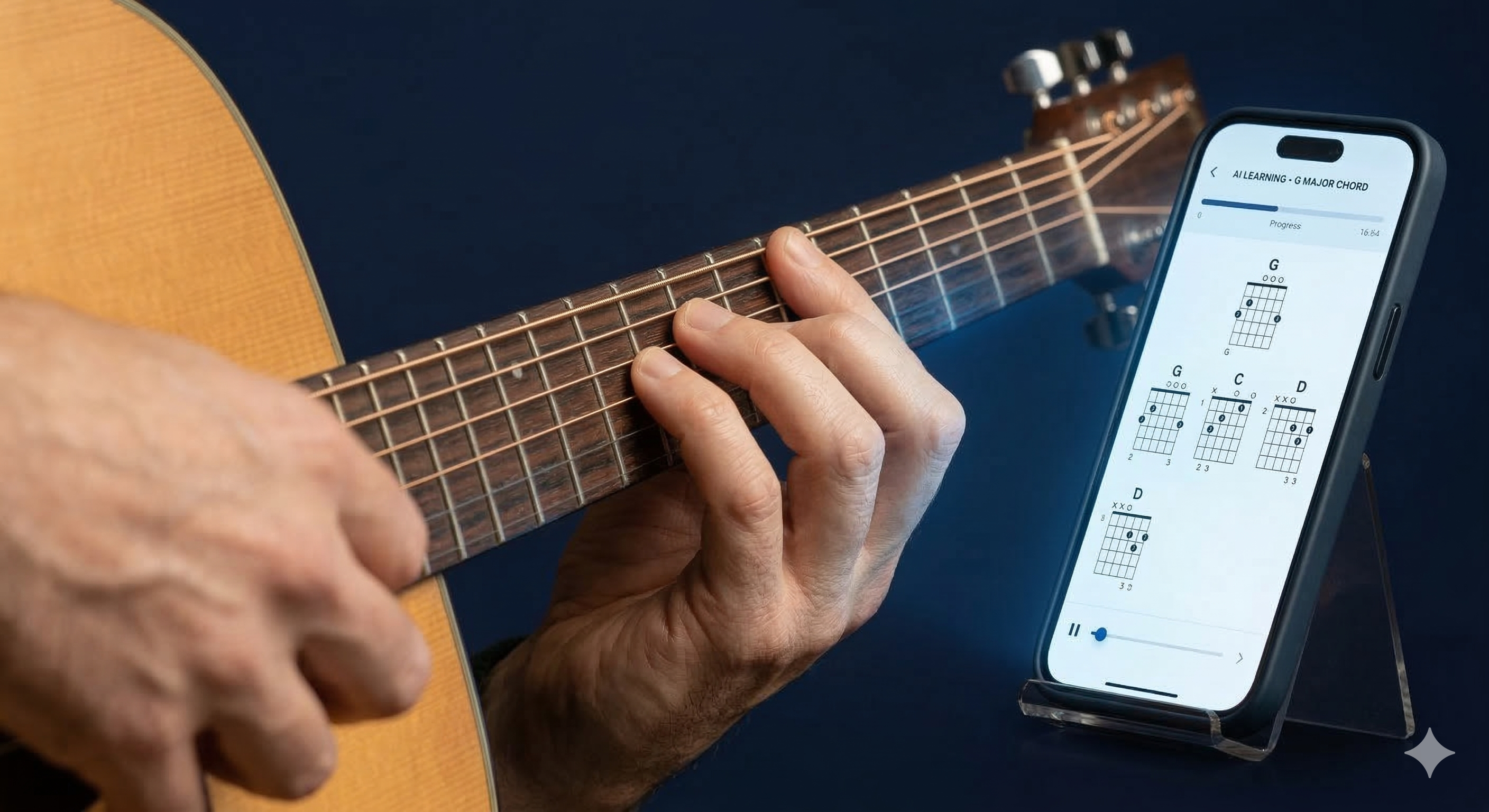
The way people learn guitar is undergoing its biggest transformation since the invention of instructional videos. Artificial intelligence has moved from futuristic concept to practical reality, and apps like Chordie AI are leading a revolution in music education. Here's how AI is fundamentally changing what it means to learn guitar in 2026.
Real-time feedback is the game-changer. Traditional guitar learning relies on delayed feedback — you play something, then later (maybe at your next lesson, maybe never) someone tells you what you did wrong. AI listens to your playing in real-time and provides instant correction. Played a note slightly off? You know immediately. Strumming tempo inconsistent? The app tells you on the spot.
This instant feedback loop accelerates learning dramatically. Research in motor skill acquisition shows that immediate feedback leads to faster improvement than delayed feedback. Every correct repetition reinforces good habits; every corrected mistake prevents bad habits from forming. AI makes this possible 24/7, not just during weekly lessons.
Personalized curriculum is the second revolution. Traditional methods offer one-size-fits-all progressions: everyone learns the same chords in the same order. AI-powered apps analyze your individual performance and adapt accordingly. Struggling with the C chord? You get extra exercises targeting that specific skill. Breezing through strumming patterns? You advance faster. The curriculum shapes itself to your unique learning profile.
Chordie AI takes this further by analyzing not just what you're struggling with, but why. The AI can detect whether your C chord sounds bad because of finger positioning, insufficient pressure, or muted strings — and provide targeted advice for your specific issue.
Song libraries have expanded beyond what any human teacher could offer. Chordie AI includes thousands of songs, each analyzed and adapted for different skill levels. Want to play a challenging song as a beginner? The AI simplifies it, showing you an achievable version while you build skills. As you improve, the app progressively introduces more complex elements until you're playing the full arrangement.
Practice gamification leverages AI to keep you engaged. Streak tracking, achievement badges, and progress visualizations tap into the same psychology that makes video games addictive — but directed toward skill building. AI adjusts difficulty to keep you in the "flow zone," challenged enough to stay engaged but not so challenged you give up.
The social element is AI-enhanced too. Some apps connect learners with similar skill levels for collaborative learning or friendly competition. AI matches you with appropriate challenges and partners, creating community around individual practice.
Accessibility has improved dramatically. AI-powered apps cost a fraction of traditional lessons while providing many of the same benefits. Chordie AI's subscription offers unlimited 24/7 access to adaptive curriculum, real-time feedback, and thousands of songs — far more hours of effective instruction than you could afford in traditional lessons.
Language and cultural barriers fall too. AI can provide instruction in multiple languages, adapt to regional music preferences, and serve learners worldwide who previously had no access to quality guitar education.
Let's be clear about what AI doesn't replace: human connection. Playing music with others, receiving encouragement during frustration, and the relationship with a mentor are irreplaceable. AI apps are tools, not replacements for musical community. Many users combine AI practice with occasional human lessons for the best of both worlds.
The skill ceiling for self-taught guitarists has risen. Previously, learning without a teacher meant hitting plateaus you couldn't identify or overcome. AI identifies these plateaus (inconsistent timing, poor technique, bad habits) that self-learners typically miss. You can now reach higher skill levels independently than ever before.
Looking ahead, AI guitar education will continue evolving. Future versions might analyze video of your hand position, integrate with smart guitars that track finger placement, or provide VR instruction. The technology is moving fast, and 2026 is just the beginning.
For learners today, the practical impact is simple: you have access to better tools than any previous generation of guitarists. Whether you're a complete beginner or returning to guitar after years away, AI-powered apps like Chordie AI offer an accelerated path to playing the music you love.
The question isn't whether to use these tools — it's how soon you'll start.
Chordie Team
VerifiedMusic Education Experts
The Chordie Team consists of professional guitarists, music educators, and AI engineers passionate about making guitar learning accessible to everyone. With decades of combined teaching experience, we create content backed by proven pedagogical methods.
Learn more about usShare this article