Nobody talks honestly about the first month of guitar. Marketing shows smiling beginners strumming confidently. Reality involves sore fingers, buzzing strings, and moments of genuine frustration. This guide tells you what's actually coming — and how to get through it.
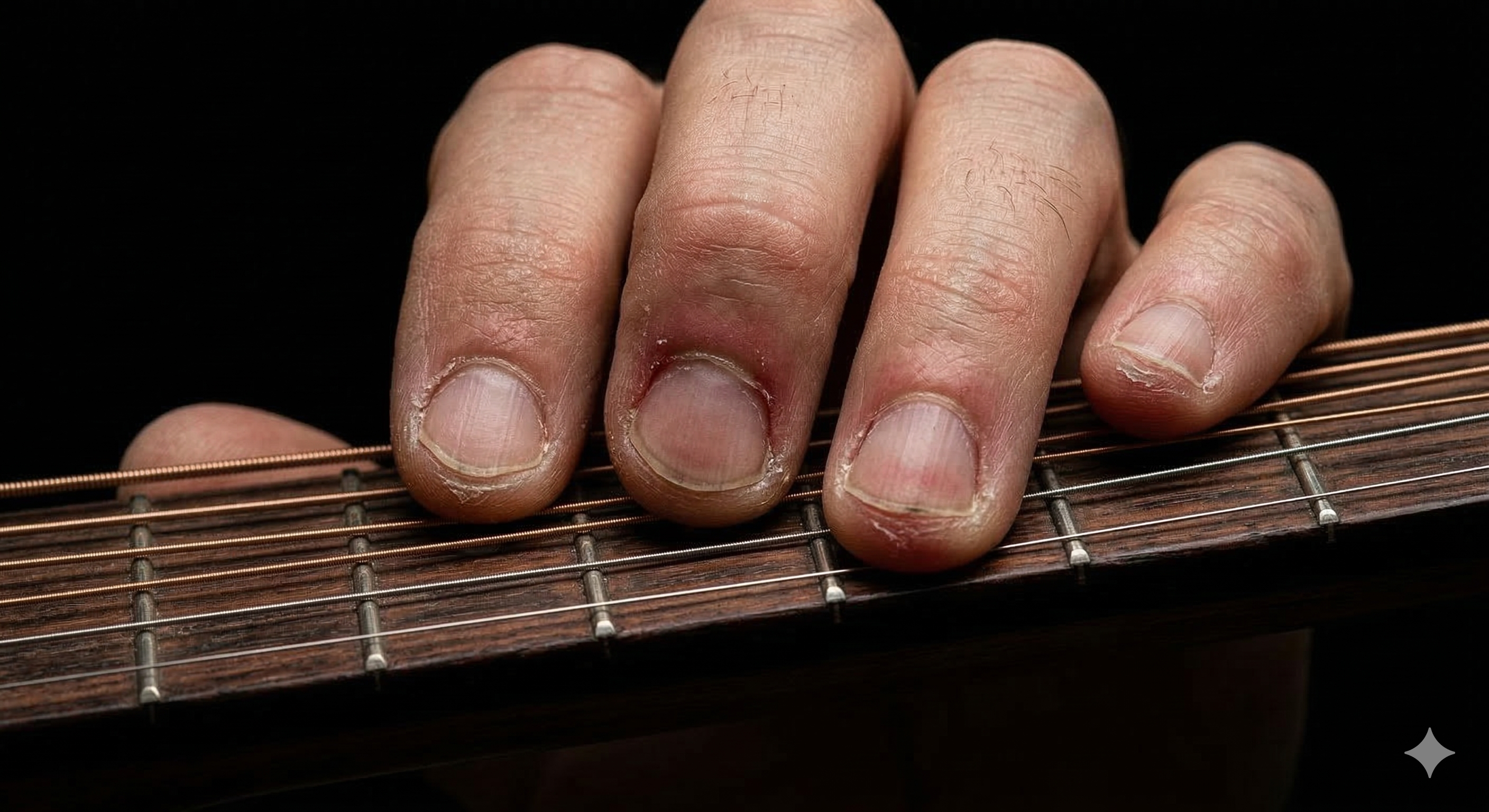
The finger pain is real. Within your first few practice sessions, your fingertips will hurt. Steel strings pressing into soft skin creates discomfort ranging from mild tenderness to sharp pain. This isn't a sign you're doing something wrong; it's a necessary phase everyone passes through.
The pain typically follows this pattern: Days 1-3, mild discomfort during practice. Days 4-7, peak pain — fingertips are tender even when not playing. Visible indentations appear where strings pressed. Days 8-14, pain begins to subside as calluses form. The skin is hardening. Days 15-21, significant improvement. Calluses are established. Practice no longer hurts. Days 22-30, minimal to no pain. You can play for extended sessions comfortably.
Strategies for managing finger pain: Practice in shorter sessions. Three 10-minute sessions cause less cumulative discomfort than one 30-minute session. Your fingers need recovery time between practice. Don't push through severe pain; mild discomfort is fine, but sharp pain means stop.
Keep practicing consistently despite the discomfort. Skipping days slows callus development. The goal is regular exposure so your skin adapts. Think of it like building exercise tolerance — you need consistent work, not occasional marathons.
Lighter gauge strings can help. If the pain is unbearable, consider switching to extra-light strings (.010-.046 or even .009-.042). You can always switch back to heavier strings once calluses develop.
Buzzing strings are the second frustration. You press a chord, strum, and instead of a clear tone, you get a muted buzz. This happens for several reasons: fingers not pressing firmly enough, fingers accidentally touching adjacent strings, fingers not positioned close enough to the fret, or strings set too low (action too low).
Most buzzing resolves with proper technique and finger strength — both of which develop through practice. Chordie AI's real-time feedback helps here, immediately identifying which strings aren't sounding clean so you can adjust your positioning.
Chord transitions feel impossible at first. You finally get the G chord sounding clean... but then you need to switch to C, and by the time your fingers find their positions, the song has moved on. This is normal. Your brain hasn't built the neural pathways yet.
The fix is deliberate practice of transitions specifically. Don't just practice holding chords — practice moving between them. Start painfully slow (maybe 30 seconds per transition), then gradually increase speed. Chordie AI's chord transition trainer is designed exactly for this.
Frustration is the invisible barrier. You'll have days when you feel like you're going backward. Days when things you could do yesterday suddenly don't work. Days when you wonder why you started this at all. This is completely normal.
Progress in guitar isn't linear. It comes in spurts followed by plateaus. Sometimes you plateau because your brain is consolidating what you've learned (even if you can't feel it). Sometimes you plateau because you need to focus on a specific weak point. Either way, plateaus end. Keep practicing.
Comparing yourself to others is poisonous. YouTube is full of "beginner" guitarists who are actually professionals downplaying their abilities or kids who've been playing for years. Comparing your week one to someone's year five is meaningless and discouraging. Compare yourself only to your past self.
Setting realistic expectations prevents frustration. After one month of consistent practice, you should be able to: hold 4-6 basic chord shapes, transition between practiced chords slowly, strum through simple songs with pauses, and feel significantly less finger pain. You should NOT expect to: play barre chords, fingerpick complex patterns, play along with songs at full speed, or impress anyone with your skills.
The truth about the first month is this: it's the hardest part. Physical discomfort, technical challenges, and slow progress combine to create maximum difficulty. If you can push through this month, everything gets easier. Calluses stay once formed. Neural pathways strengthen. Chords become automatic. The frustration-to-fun ratio shifts dramatically in your favor.
Chordie AI helps by providing structure (so you know what to practice), feedback (so you know you're improving even when it doesn't feel like it), and encouragement (tracking your streaks and celebrating milestones). But ultimately, getting through the first month requires you to show up despite the discomfort.
You can do this. Every guitarist you admire went through the same painful, frustrating first month. They pushed through. So can you.
Chordie Team
VerifiedMusic Education Experts
The Chordie Team consists of professional guitarists, music educators, and AI engineers passionate about making guitar learning accessible to everyone. With decades of combined teaching experience, we create content backed by proven pedagogical methods.
Learn more about usShare this article